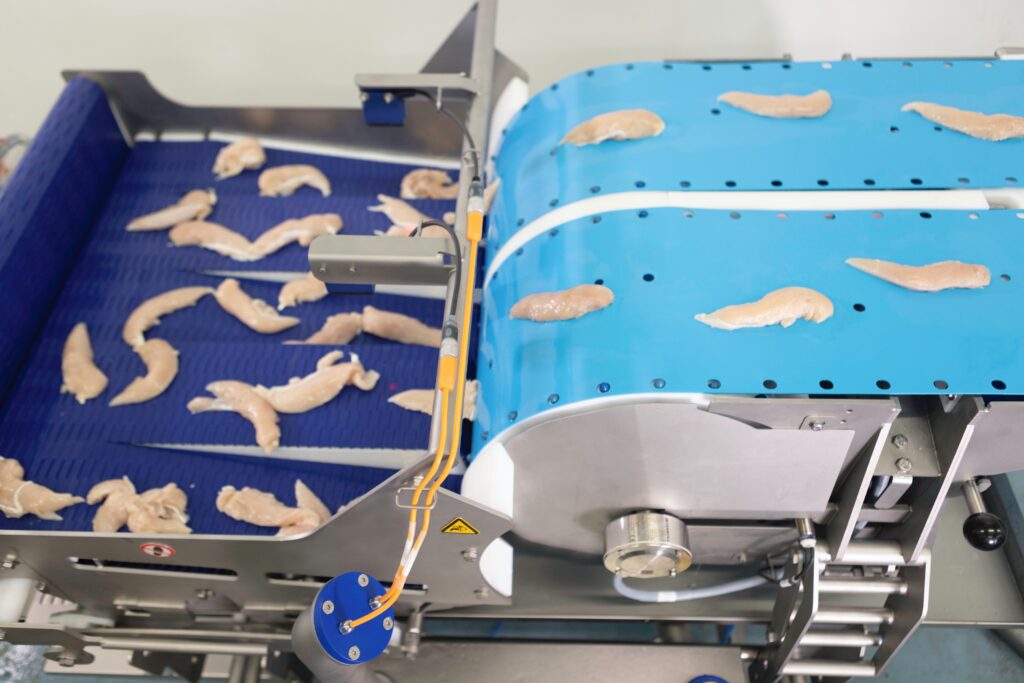
In October, JBT Marel introduced SingleFeed, a dual-lane singulation system that separates bulk boneless poultry products into single pieces for further in-line processing, taking over manual work that needs two to six operators depending on line speed and application. It is designed for processors that hold tenderloins or fillets in bulk batches or a random flow but must fill fixed-weight or fixed-count retail trays.
From a bulk bin and a gooseneck conveyor, products drop into SingleFeed, where counter-running conveyor belts guide them towards two continuously running belt lanes that work on a vacuum principle. The dual-lane singulation system handles tenderloins, breast fillets, deboned thighs, strips and sandwich fillets, and its footprint is compact.
Typical uses are off-line bulk processing and an in-line random product flow: breast meat from the deboning system with no immediate retail order, or fillets and tenderloins bought in batches of 1,000 kg (about 2,200 lb) that must become retail trays of 600 g (21.1 oz). Singulated products leave on the belt ready for a grader, SensorX, RoboOptimizer with I-Cut, RoboPacker, RoboBatcher or any other system that needs an infeed of individual pieces.
Water use was a design focus for air-chilled markets, where adding water to the product is generally disapproved of; in water-chilled markets such as the US, products are already wet. SingleFeed does not wet the products and only lightly moistens the conveyor belt, so they remain mostly dry throughout the process, as products in trays must not leak water or appear wet.
Operators set the singulation speed on an HMI touchscreen, which makes it simple to synchronise with a downstream grader, and the internal software matches the speed of the belts before and after the unit to prevent product overload or delays. Lane offset and product spacing are the other main adjustments. Alerts appear on the HMI screen, and remote login gives access to support from the JBT Marel helpdesk worldwide.